









Live. Laugh. Smile.
Airway Orthodontics
Sleep Disordered Breathing (SDB) encompasses all sleep disorders and ranges from habitual snoring to obstructive sleep apnea (OSA). It is a medical condition with significant consequences in developing children, including affecting parts of the nervous system that help with learning, thinking, attention and memory. Therefore, early detection is essential! While dentists and orthodontists play a key role in the screening of SDB, the actual diagnosis and management of this condition rests on professionals in the medical field that hold a medical license in the United States and Canada.
There are several underlying biological or pathophysiological factors that predispose a patient to present with physical symptoms related to SBD. As such, treatment of SBD must address the specific cause of the condition. For example, a patient with Type I diabetes cannot be treated with the same drugs and dietary changes as Type II diabetes. Similarly, one cannot treat obstructive sleep apnea in a patient with an expander if the cause of the condition is an issue related to weak airway muscles. Diagnosing is key!
Anatomic factors that may predispose a patient to SBD include, but are not limited to enlarged adenoids or tonsils, increased soft tissue volume or fat in the components of the tissues that make up the throat (pharynx), large tongue or increased fatty tissue within the tongue. Non-anatomic factors include collapse of the airways due to weak muscles, or a central nervous system that does not control breathing properly. For example, patients may have an unstable breathing control system where the brain over-reacts to changes in blood gasses like carbon dioxide, while others may have a condition in which the brain or body reacts intensely to brief, repeated interruptions in sleep cycle. Therefore, diagnosis is key to the management of SDB so that the treatment can be tailored to address the underlying reason that is causing disturbances in sleep.
Assessment of Sleep Disordered Breathing
An assessment of SBD at the orthodontic office includes a questionnaire to review the patient's dental and medical history and an evaluation of snoring, mouth breathing and nasal obstruction. Orthodontists will also evaluate the size and position of the tongue, the size of the tonsils and adenoids and overall physical airway space at the back of the throat, presence of overweight and obesity and general growth and development of the patient. If SBD is suspected, the orthodontist will refer the patient to their primary care physician for accurate diagnosis of SBD or OSA. Many dentists and orthodontists are using Cone Beam CT and cephalometric x-rays to diagnose skeletal and dental malocclusions. The American Association of Orthodontists notes that these tests have no diagnostic value in risk assessment or diagnosis for SBD.
Assessment with an Ear Nose and Throat doctor will include assessing the anatomical factors that may cause difficulty breathing, including the size of the tonsils and adenoids, the size of the tongue, or nasal obstructions including deviated nasal septums or nasal polyps.
Assessment with a Sleep Medicine physician will likely include a sleep test, also known as a polysomnography, in the diagnosis of OSA. It is important to note that any home sleep tests such as Nox3 and SleepImage Ring should not be relied upon for diagnostic value when ordered by professionals who are not physicians. In fact, polysomnography and a clinical evaluation of symptoms associated with OSA remains the gold standard in diagnosis of this condition.
Orthodontics and Pediatric Obstructive Sleep Apnea
Sleep Disordered Breathing (SBD) has shown to spontaneously correct itself in children over time. Studies show that younger patients who snore at night or have mild symptoms of sleep disordered breathing are not at risk to progress to severe SBD. Furthermore, patients who experience obstructive sleep apnea usually "grow out of it" during the transition to puberty. However, young male patients and young patients who are overweight are still at risk of SBD and should be followed carefully. Nevertheless, if SBD is suspected, a clinical evaluation by a medical practitioner is warranted.
Once a proper diagnosis of the cause for sleep disordered breathing has been made by your medical practitioner, and the diagnosis shows an anatomical issue with the upper airway, there may be a need for orthodontic intervention if removal of the adenoids and tonsils does not help. A 2023 study by Yu et al. showed that patients had less apneic episodes during sleep if rapid palatal expansion (RPE) is completed following removal of tonsils and adenoids.
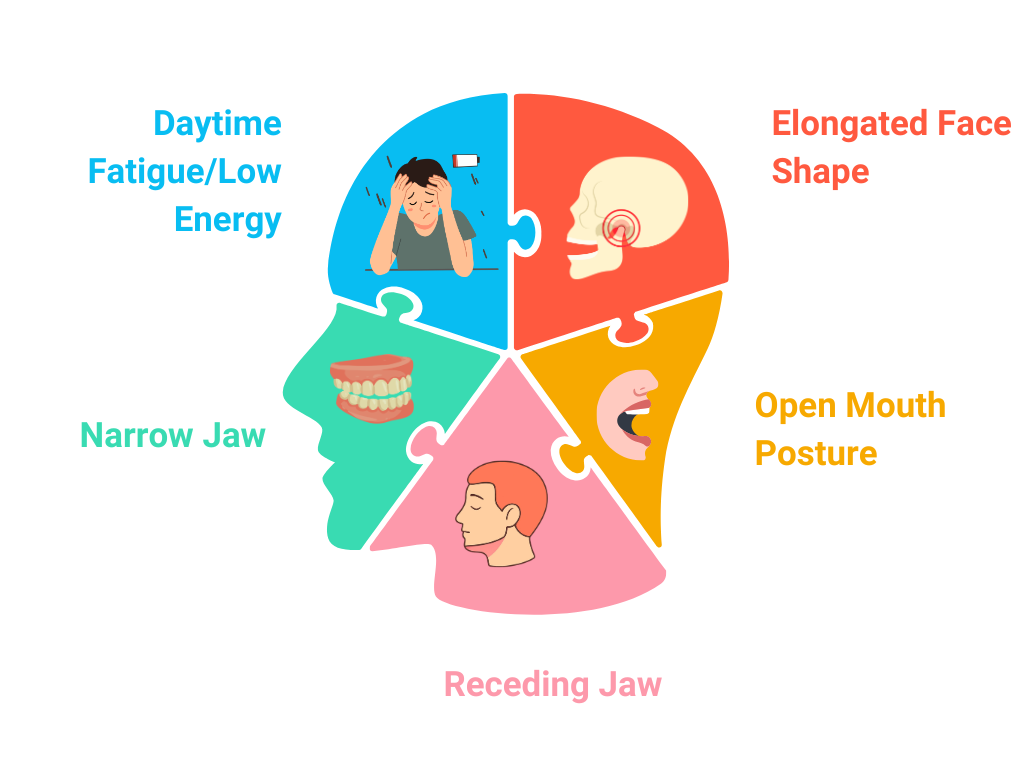
Palatal expansion takes advantage of a child's suture that is not fully developed. The suture is present in the upper jaw and separates the two halves of the jaw. Before puberty starts, the suture is soft, which allows for expansion of the jaw and the floor of the nose. Since the nasal and mouth floors are connected, using RPE to expand the upper jaw can help increase airflow within the nasal airways for better breathing. It is important to note there is no evidence to suggest that early prophylactic treatment of very young patients (less than 7 years of age) with palatal expansion helps to prevent the development of SBD. Patients should be assessed for potential expansion at around 6 years old when the width of the jaw has fully developed. This assessment is essential to determine the presence of a crossbite (indicating the upper jaw did not grow ideally) and the existence of other dental abnormalities related to the jaws and teeth.
Orthodontics and Obstructive Sleep Apnea in Adults
Studies have shown that sleep disordered breathing worsens over time in adults over 50 and is likely related to age-related issues and reduced tone of the muscles around the airway that allow it to collapse easily. Other factors that increase the risk for obstructive sleep apnea in adult patients include: age, family history, high BMI, thick neck and enlarged tonsils. Again, diagnosis is key to determining treatment options that target the cause.
In patients with mild sleep apnea, mandibular advancing devices may be used. These appliances advance the lower jaw and tongue and prevent airway collapse. They mechanically stretch the walls of the throat and maintain it open. These devices have shown to reduce apneic events by 48–67% in adults during sleep. However, they do come with some side effects, including irreversible changes in the bite that may require future orthodontic treatment.
Currently, Continuous Positive Airway Pressure (CPAP) therapy remains the gold standard to treat OSA in adults with moderate to severe sleep apnea. A CPAP machine helps treat sleep apnea and provides air through the nose and mouth to help patients breathe while they sleep. In patients who are non-compliant with this therapy, orthodontics in combination with surgical advancement of the lower or upper and lower jaws is a viable option.
Take a look at some questions patients usually have:
No. Orthodontists are trained to recognize signs and risk factors of OSA, but only an ENT or sleep medicine physician can formally diagnose it. If we notice signs during your visit, we'll refer you to the right specialist.
Palatal expansion can meaningfully improve nasal airflow, especially in combination with removal of adenoids and tonsils. However, diagnosis is important as expansion alone cannot prevent or correct sleep disordered breathing.
Common signs include mouth breathing, snoring, restless sleep, dark circles under the eyes, and a dry mouth on waking. If you notice these in yourself or your child, it's worth bringing up at your next visit.
Some patients and parents believe that removing teeth can have negative effects on the development of jaws and breathing. This is a misconception that has been circulating social media recently and has caused much controversy. Current evidence shows no association between tooth removal and sleep disordered breathing. Research has shown that premolar extractions during comprehensive orthodontic treatment have little to no effect on airway breathing. Further, several studies have found that even if multiple teeth, including front teeth, are removed, there is still no effect on intraoral airway space.
If you've come across information regarding the airway and have questions about your own treatment plan, we are happy to walk through any questions or concerns that you have. Your safety and comfort is Dr. Virdee's first priority, and she will provide her own insights along with information that is supported by clinical research.
There is significant misinformation about tongue ties on social media. According to the American Association of Head and Neck Surgery on ankyloglossia (tongue tie) in kids, surgery to release a tongue tie should not be performed, as the anterior tethering of the tongue serves to prevent posterior collapse of the tongue — releasing the frenulum could lead to OSA worsening. They have concluded that a tongue tie does not cause obstructive sleep apnea in children and is not indicated to prevent or reduce the symptoms of obstructive sleep apnea.
While the American Academy of Pediatrics guidelines note the benefit of releasing tongue ties for latching in infants, they note that there is no evidence for releasing tongue ties for speech difficulties or preventing obstructive sleep apnea.
1. Behrents RG, Shelgikar AV, Conley RS, Flores-Mir C, Hans M, Levine M, et al. Obstructive sleep apnea and orthodontics: An American Association of Orthodontists White Paper. Am J Orthod Dentofacial Orthop. 2019;156(1):13-28.e1.
2. Krishnan V. Deciphering orthodontist's role in obstructive sleep apnoea management. J World Fed Orthod. 2020;9(1):1-2.
3. Larsen AJ, Rindal DB, Hatch JP, Kane S, Asche SE, Carvalho C, et al. Evidence Supports No Relationship between Obstructive Sleep Apnea and Premolar Extraction: An Electronic Health Records Review. J Clin Sleep Med. 2015;11(12):1443-8.
4. Machado-Junior AJ, Zancanella E, Crespo AN. Rapid maxillary expansion and obstructive sleep apnea: A review and meta-analysis. Med Oral Patol Oral Cir Bucal. 2016;21(4):e465-9.
5. Papageorgiou SN, Zyli M, Papadopoulou AK. Extraction of premolars in orthodontic treatment does not negatively affect upper airway volume and minimum cross-sectional area: a systematic review with meta-analysis. Eur J Orthod. 2025;47(2).
6. Ramar K, Dort LC, Katz SG, Lettieri CJ, Harrod CG, Thomas SM, et al. Clinical Practice Guideline for the Treatment of Obstructive Sleep Apnea and Snoring with Oral Appliance Therapy: An Update for 2015. J Clin Sleep Med. 2015;11(7):773-827.