









Live. Laugh. Smile.
Teens
Missing Teeth
Many patients don’t know they are naturally missing teeth until they see a dentist or orthodontist. There have been several cases in our office where we have taken a routine x-ray just to find out that a patient does not have one or more permanent teeth growing under their baby or primary teeth. This is exactly why the American Association of Orthodontists recommend a routing check up with an orthodontist by age 7, when the first set of permanent teeth start to erupt.
The most common congenitally or naturally missing teeth are the lower second bicuspids (5th tooth from the centre) followed by the upper lateral incisors (second tooth from the centre), followed by a lower central incisor. Patients can be naturally missing one or several teeth and is usually dependent on race and family history. For example, caucasians of European descent show the most missing teeth at around a rate of 4.5-6%. The risk of missing teeth in a child increases to between 20-50% if a parent is also missing teeth.
If a primary tooth has not shed at the right age, an orthodontist will take a routine x-ray to determine the following:
What if I have missing teeth?
There are three ways to treatment plan a case when a patient is missing teeth:
The orthodontist will determine the ideal treatment plan is based on the patient profile, the current smile esthetics, the bite, and the crowding that is present.
Space closure and substitution of adjacent teeth for missing teeth
Space closure and substitution of adjacent teeth for missing teeth has the advantage of minimizing the need for implants or bridges which requires extensive dental treatment and carries a financial cost. The disadvantage of this option is that the substituting teeth will never look esthetically the same as the missing teeth. We typically substitute upper canines for upper lateral incisors when the canines have a small size and shape similar to the lateral incisors. The dentist re-shape the canine by adding resin to it or reducing the cusp tip to make it look like a lateral incisor.
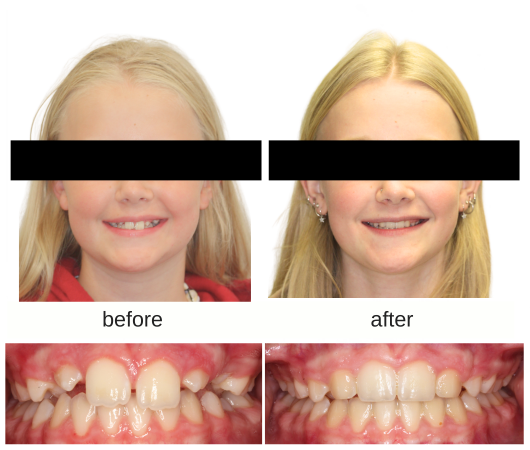

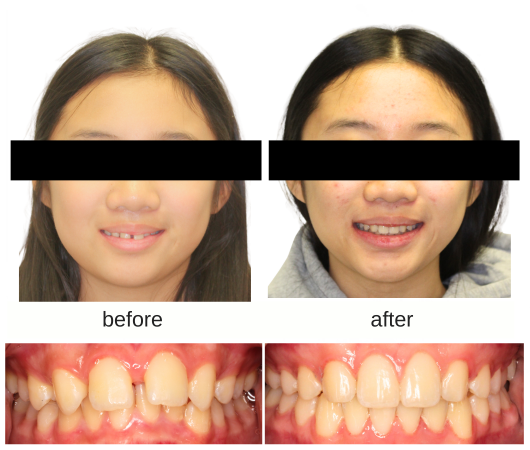

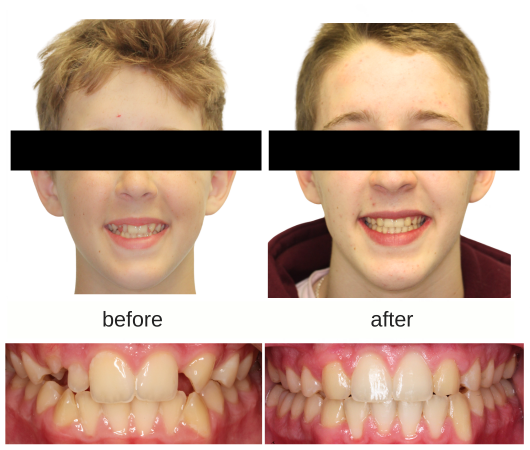
All patients underwent a treatment plan with canine substitution where the upper canines resemble the upper lateral incisors due to conginentially missing upper lateral incisors.
Idealizing space for implants or bridges
Creating space for implants and bridges is the ideal treatment plan when a patient has ideal smile esthetics. However, implants can only be placed once the patient stops growing (anywhere between 19-21 years old). Therefore, a solution is required in the interim to replace the missing teeth. This may include a removable retainer with a fake tooth or pontic, a bridge, or a pontic or fake tooth bonded to a permanent wire. While the removable retainer is a good option, one has to remove it to eat. Many patients do not like this option when eating in public. A bridge that replaces a fake tooth is great as an alternative but comes at a great cost and is at risk of breaking. The last option, a fake tooth bonded to a permanent wire is also a nice option but is prone to breakage and the pontic can sometimes discolour.
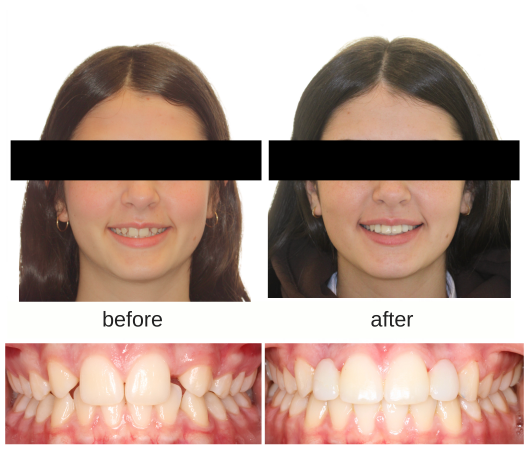
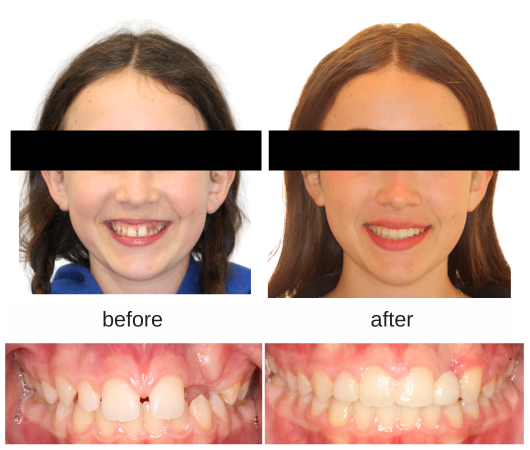
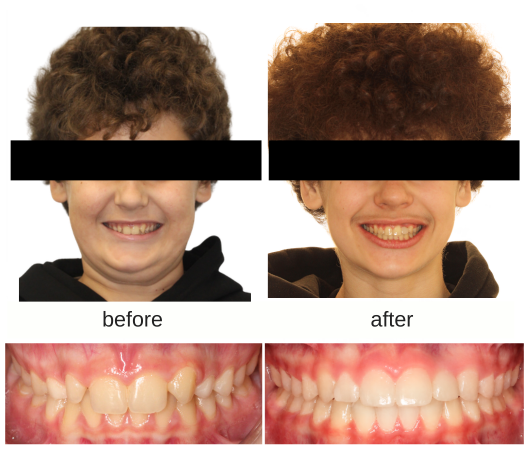


All patients were treated with braces to idealize spacing for a pontic or bridge. The pontic or bridge will stay until the patient is ready for an implant.
Auto-transplantation
Autotransplantation is used when a patient is missing more than 4 teeth or has a missing tooth on one side but significant crowding in another area. This approach is commonly done in Europe, although Dr. Virdee has been successful in utilizing this approach in several of her patients in the past.
In this procedure, a patient will have their own tooth extracted from one location and placed in another location in their mouth. This procedure is usually completed by an oral surgeon while the space for the tooth to be located in a new area can be gained through braces. It is important for the root of the auto-transplanted tooth to be partially formed to allow the blood vessels to grow back into the tooth. A tooth root that is fully formed is usually not a good candidate for auto-transplantation. The auto-transplated tooth and the surrounding area is then closely monitored to ensure the bone is accepting the tooth. The presence of a periodontal ligament around the auto-transplanted tooth is a good sign that the procedure is successful.
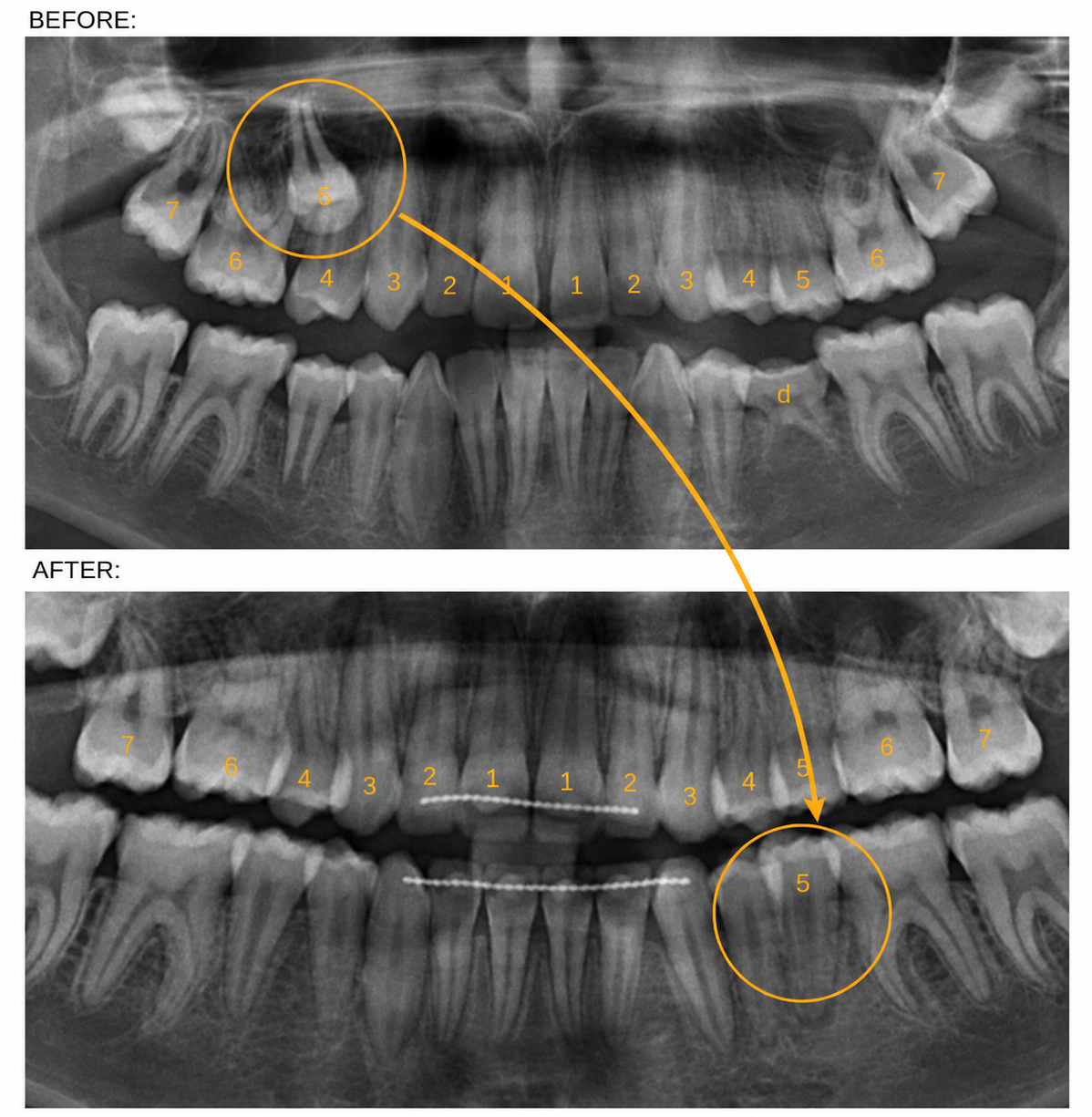
This patient came in with an impacted upper left premolar (5) and a missing lower right premolar with a primary tooth (d) with short roots in its place. There wasn't a way to make room in the upper jaw for the impacted tooth without causing negative implications to the teeth (i.e., flaring the upper incisors). Since the patient is missing the lower right premolar, the best decision was to bring the impacted tooth in place of the missing adult tooth through autotransplantation. With the help of the surgeon, we were able to make this happen and leave the patient very happy with their result!
What option is best for each patient depends on their case. If you have missing teeth, please feel welcome to consult Dr. Virdee with a complimentary consultation.