










Live. Laugh. Smile.

Springs (Forsus)
Typically mild to moderate overjet can be corrected with Class II elastics. However significant overjet may require a special type of appliance known as the Forsus spring.
The 3M Forsus springs or appliance is traditionally used as a way to correct the bite and reduce the distance between the upper and lower front teeth (overjet) without using elastics. Patients like this option because it eliminates the need for compliance with elastics. The Forsus springs are typically installed 6-8 months after treatment is initiated as the patient has to be in stiff wires for the appliance to be installed. The appliance is in place for 4-6 months depending on the amount of correction that is required.
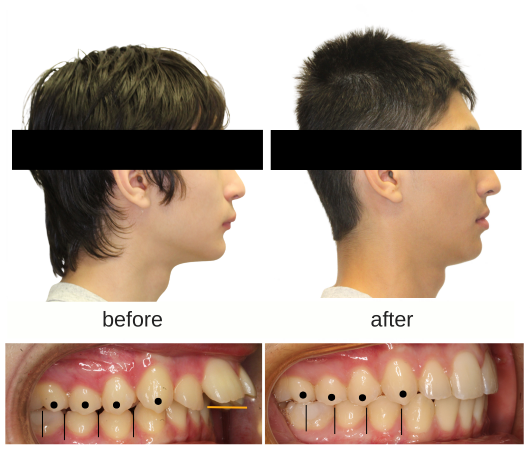
In patients with severe bite discrepancies (ie where the cusps of the upper teeth outlined with (•) do not line up between the valleys formed by the lower teeth (|)), a forsus appliance in combination with braces, is used to correct both the bite and the overjet (horizontal distance between the upper and lower teeth, outlined in yellow horizontal line).
What are components of a Forsus Appliance
The Forsus spring has two parts: A module that attaches to the upper first molars and rods that are crimped around the lower wire. These molars are initially banded - which means that we place a ring around these teeth instead of brackets. Molar bands or rings allow for the module to be inserted into the tube with superior retention compared to a regular bracket or brace.
The Forsus module is a hollow tube so it can receive the rods that attach to the bottom wire. The rods come in various sizes and Dr. Virdee selects the size of the Forsus rods to determine which size will result in slight activation, which means that the patient will feel slight forward pressure on their lower jaw. The forward pressure stimulates growth of the lower jaw forward. Some patients tend to push their lower jaw forward until they do not feel the pressure of the springs. This is not recommended as the springs will no longer be active and adequate bite correction cannot be achieved within the desired time.

After initial insertion of the Forsus appliance, the teeth will move so that the bite starts to align. We usually see patients with the Forsus appliance every four weeks to activate the rods with a 2-3mm crimp that is placed on the rod. This compresses the module to help produce more force to gradually correct the bite to ideal standards.
What is the patient's experience with the Forsus appliance?
Based on clinical experience, most patients do well with the Forsus springs. Patients who are not compliant with elastics are the biggest fans of the Forsus appliance. The appliance is narrow and streamlined and sits against the teeth and mildly abuts the cheeks. Most patients get accustomed to the appliance within a week. When we see patients for their initial check up and ask them about their experience with the Forsus springs, a majority of patients tell us "It wasn't as bad as i thought it would be." Most patients will feel mild discomfort of their teeth just like a typical orthodontic adjustment. We recommend Advil if there is significant discomfort.
Things to expect with the Forsus Appliance
1. Because the rod is inserted in the hollow module, it can sometimes come out of the module. This happens most often if a patient opens their mouth wide while yawning or laughing so that the mouth is stretched open to its maximum opening. Many patients are able to reinsert the rod back into the hallow tube of the module when this occurs.
2. Irritation can sometimes occur to the inside of the cheek, just like when someone gets braces for the first time. Using wax or adding cotton rolls between the cheeks and the rods help to create a buffer zone to limit irritation until the tissues get accustomed to the new appliance
3. Brackets can break in any orthodontic patient, especially when they eat hard, sticky or chewy foods. However, because the Forsus appliance puts force on the lower brackets, sometimes this can result in increased breakage of the brackets directly adjacent to the rods. If the lower bracket does break we usually repair this by bonding dental resin to the tooth and the orthodontic wire.
Springs Smile Gallery


All patients were treated with the Forsus spring appliance in combination with braces to correct their overjet, bite relationship, and achieve an ideal smile.